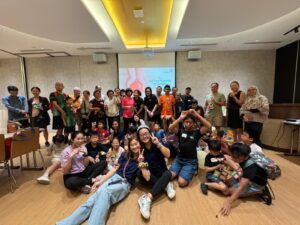


What an Incredible Day at Purple Parade 2025! 💜
On 25th October 2025, Singapore came together for a truly inspiring celebration of unity and inclusion at Purple Parade 2025.
A big part of the joy in caregiving for children comes from being made to see things from a fresh child-like perspective. Teaching autistic children requires one to go beyond that. Often, one has to tap on that perspective and the child’s interest to engage them in learning about our neurotypical world. This is the story of Eliz’s creative teaching journey inspired by her foster child, Eugene.
Eugene was diagnosed to be autistic at the age of 3.5 years. That was 3 years after he was welcomed into the foster care home of Eliz and her husband, Alan. What they knew of autism was ‘rigidity’, ‘non-social’ and ‘meltdown’.
“Eugene was a calm and easy baby. We didn’t think it was correct. Secretly, we hoped it was a wrong diagnosis. But the point of fostering is to give love and care; that’s why we foster. So, we wanted to focus on that and not dwell on the challenges ahead.”
When Eugene was enrolled in an EIPIC programme, Eliz held a full-time job. She had some time to spend with Eugene every day, but she faced a small challenge.
“I’m not the playful kind of mummy. I didn’t know how to play with a child, but I wanted to engage him, you know, to spend quality time with him. So, I ended up teaching him.”
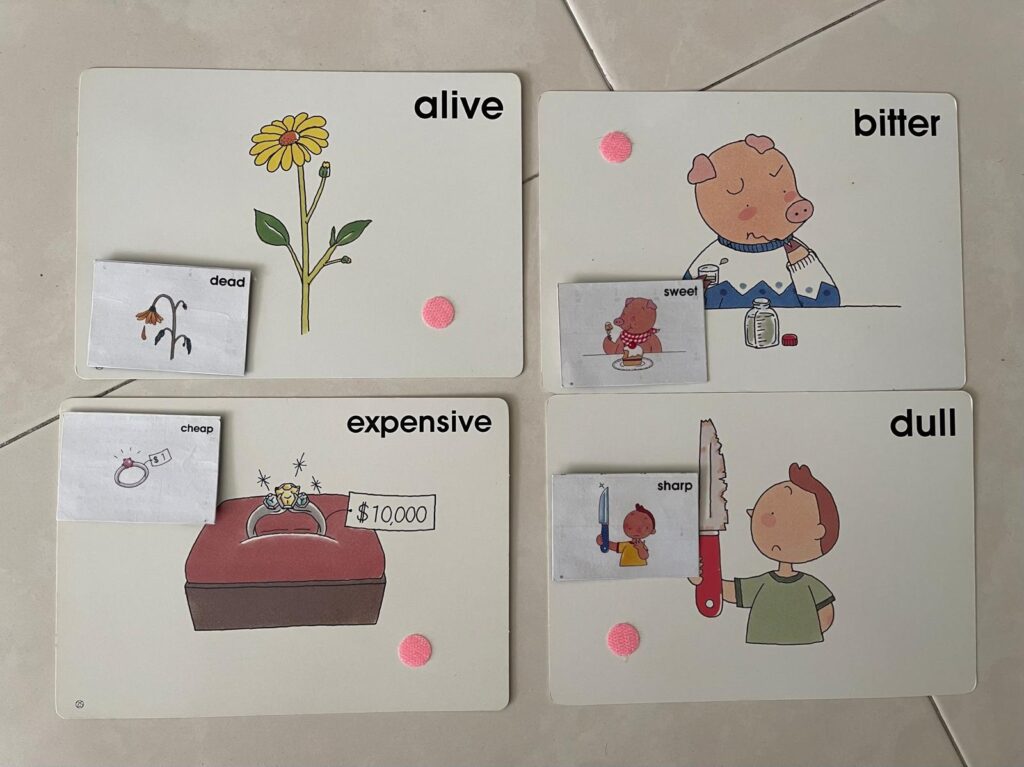
Like all parents, I had flashcards. So, I made full use of them. I scanned and printed smaller versions of the flashcards. I used them to teach him vocabulary words, to match and (in this photo) to introduce opposites to him. I was surprised how fast he learnt, maybe because it was the same set of visuals and he quickly got familiar with them.
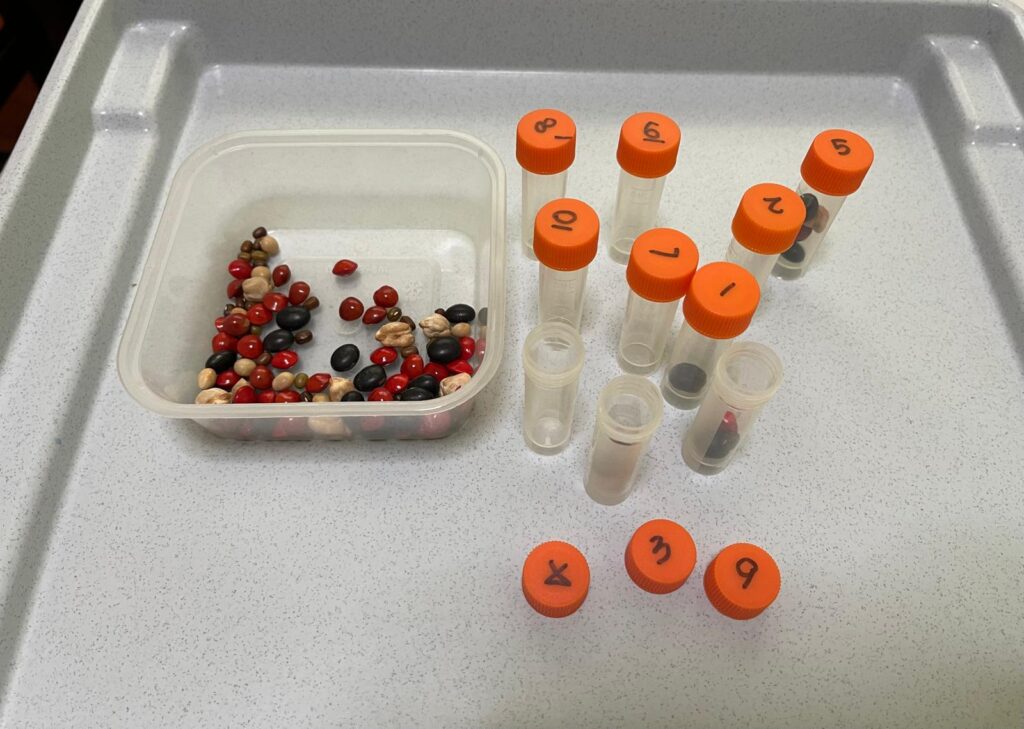
He was learning to count. His educational therapist then used beads and plastic counters as manipulatives for counting. I didn’t want to buy so many things so I used seeds. Chickpeas, green beans, black-eyed peas, red saga seeds… and I collected medicine bottles and labelled the caps. It was such a sensory experience; the seeds all had different textures and sizes. He also learnt that he couldn’t fit 10 saga seeds in the small bottle so he had to be flexible and problem-solve.
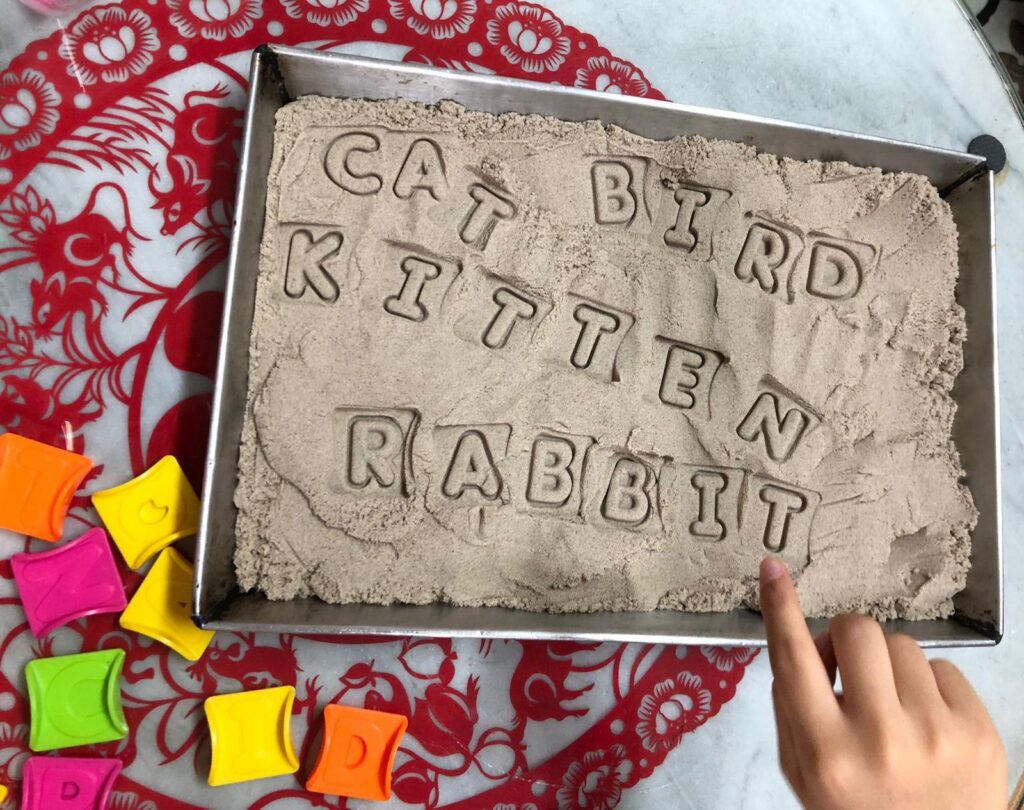
When he was in EIPIC, I realised that although he knew words and the meanings, he could not spell out and write yet. I had to think of a way to help him spell. I bought kinetic sand and the alphabet moulds were given by a friend. With these, he was able to spell and show me the words he learnt.
When Eugene was 5 years old, Eliz made the decision to leave her job in order to prepare him to take an IQ test required for primary school placement. However, she quickly realised the first thing she had to practise with Eugene was more behavioral than cognitive. He needed to slow down and follow verbal instructions better.
“He would run to the bathroom when it was time for a shower. I remember practicing walking to and from the bathroom with him, instead of letting him just run. I wanted him to understand he has to slow down and do things with me, or other people who are taking care of him. This is also an important behavior when we go out; he has to walk together with me. It is not safe if he just runs off.”
Eugene started attending a SpEd school in the east in 2023. His Individualised Education Plan (IEP) goals started to advance towards more abstract cognitive concepts, like sequencing and money. Yet, as Eliz soon found, the conventional approach of ‘teach and drill’ was not effective for Eugene. She did a lot of contemplation each time he seemed to stagnate and not seem to be engaged on a specific topic – why didn’t that method work for him? Is there a more hands-on way? Maybe I can connect this to his interest?
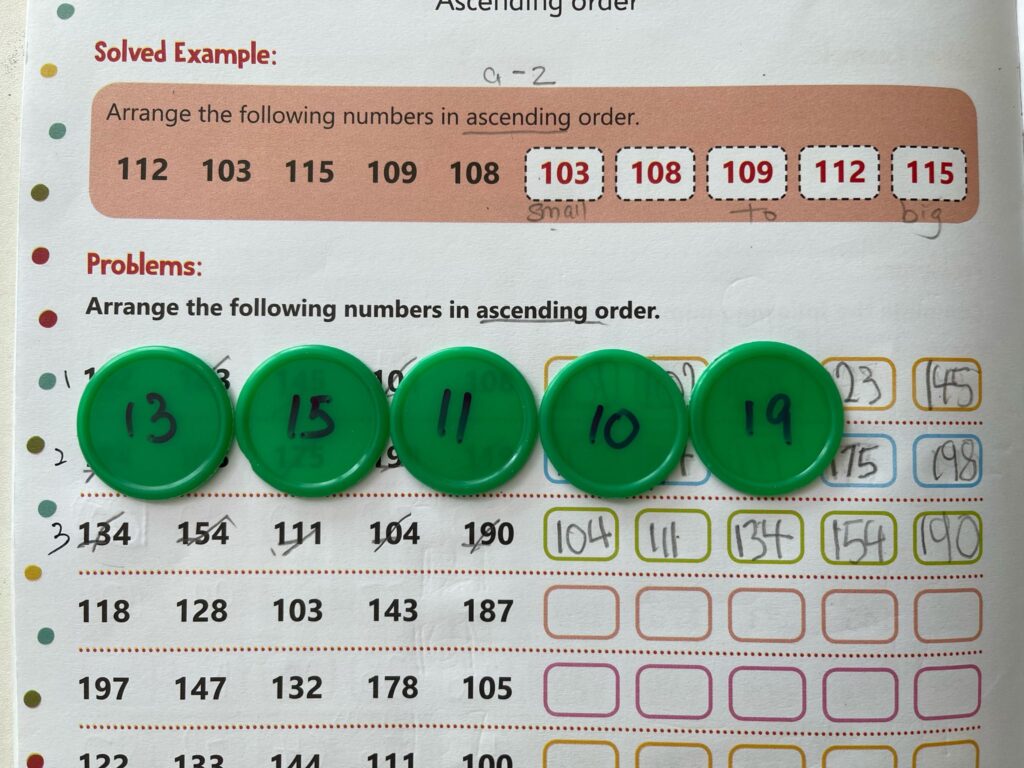
I used assessment books too. The problem is, they don’t work for him. I tried circling, highlighting, underlining, but he was so fixated on comparing the ones. I suddenly had an idea of writing the hundreds and tens on Mahjong chips so he could focus on comparing those. It’s like ‘ding!’ He moved the chips around and got it immediately.
The school was teaching how to identify and count money. To him, $2.30 was two-thirty. I did this to show him the proper way to say it is two-dollars-and-thirty-cents.
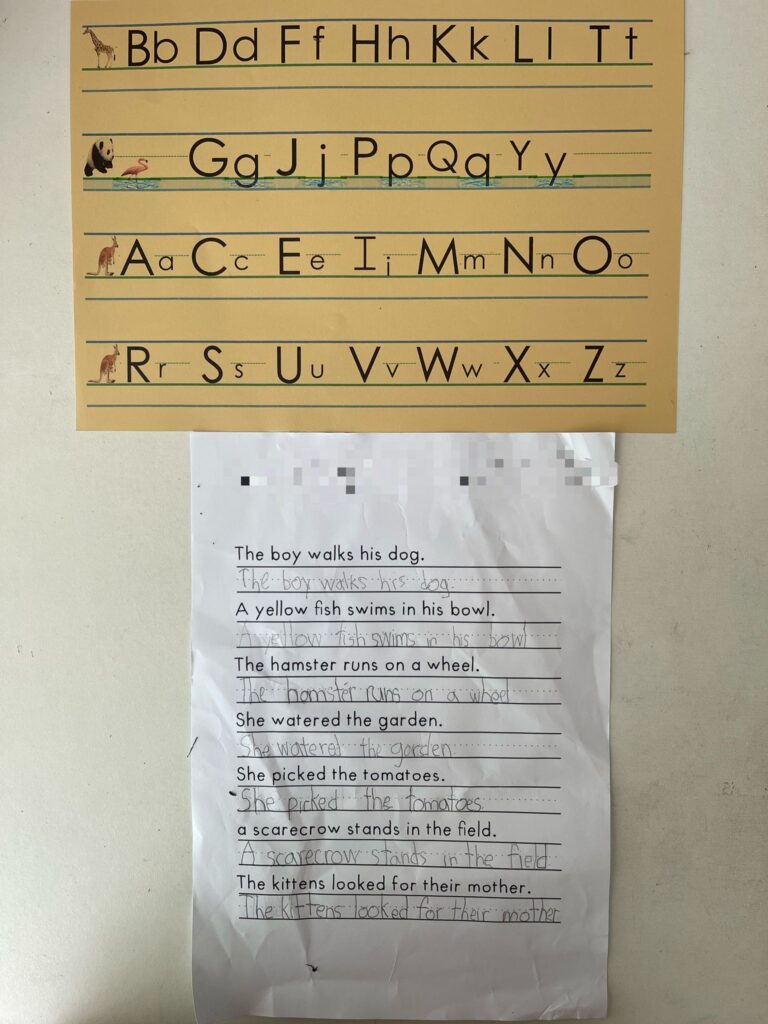
In school, teachers were using nature – sky, clouds, grass, ground – to help students write good-sized letters on the line. Eugene didn’t seem to get it. The first sentence was done in school. Another caregiver from CaringSG shared that she changed the nature elements to transportation, which was the interest of her child. I was inspired and decided to tap on Eugene’s interest in animals instead. So, there were giraffe letters (tall), kangaroo (upper case letters) and joey (lower case letters), and flamingo. Why flamingo? Because these letters have tails that extend below the line, like the legs of a flamingo submerged underwater. His handwriting definitely improved (in this photo, second line onwards).
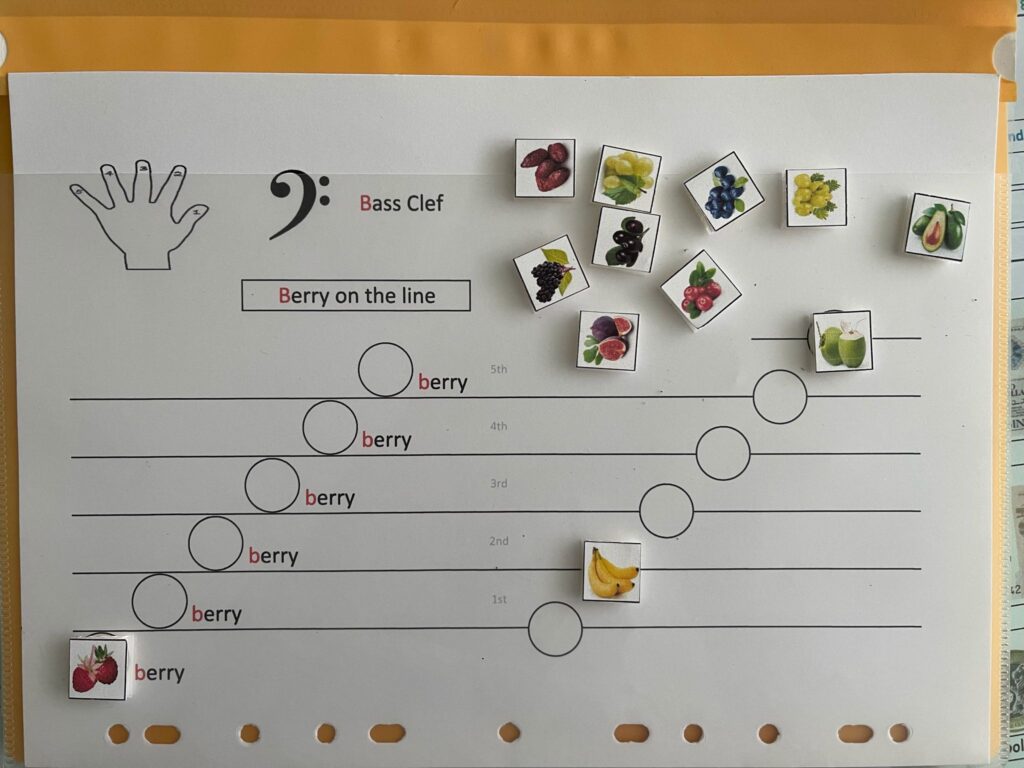
He is learning to play the piano now. He likes it but the musical notes are a bit challenging to read off. So, I thought, what can he associate them with? He loves fruits. So, all these letters became fruits. The notes on each line are a different berry. He relates to them easier and it helps him to remember.
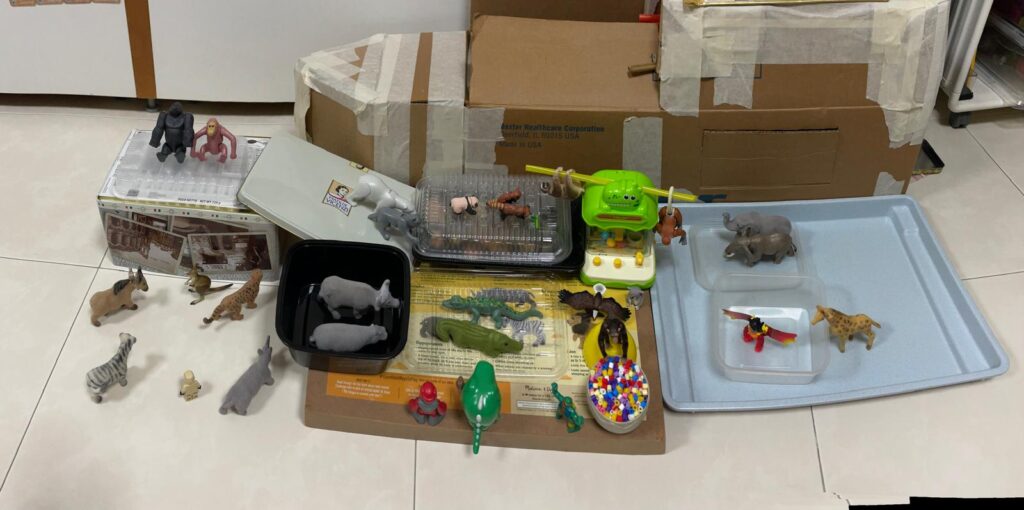
We have down times too. I just let him play while I rest or do my own chores. One day, I walked into this. He made this with the stuff he could find in the house. Guess what this scene is? Noah’s Ark! His favourite story.
Yes, caregiving for an autistic child comes packed with challenges. Yet, Eliz sees them as unexpected opportunities for creativity inspired by her foster son. Is it tiring? Sure. But to Eliz, it’s never dull.
Anything to share with other caregivers reading of her creative journey?
“Academic results are really secondary to independent living skills. Self-regulation, problem-solving skill, confidence, passion to keep learning… These are more important. I share the ways I use to teach Eugene, but they might not work for every child. You got to figure out, know your child well and figure out what works.”
Note: Names have been changed to protect the privacy of those involved.

On 25th October 2025, Singapore came together for a truly inspiring celebration of unity and inclusion at Purple Parade 2025.

On 31st August 2025, a total of 56 CaringSG members — caregivers and their loved ones with physical, intellectual, and neurological impairments — came together at NTUC Club’s multipurpose hall, Singpost Centre to celebrate the last day of August with a BIG Sports and Wellness Bang!

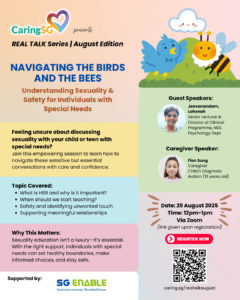
Teaching children about sexuality and healthy relationships is never an easy task, and for parents of children with intellectual disabilities and autism spectrum disorder (ASD), the challenges can feel even more overwhelming. To support caregivers on this journey, CaringSG recently hosted a webinar featuring expert insights and heartfelt sharing from both a professional and a parent, offering practical guidance, reassurance, and hope.

On 11 August 2025, 62 participants — including caregivers, persons with disabilities (PwDs), and their family members and loved ones, volunteers and CaringSG team — came together for a memorable SG60 celebration at Bird Paradise, Mandai.

On 3 August 2025, CaringSG proudly joined the nation in commemorating Singapore’s 60th birthday at the National Day Istana Open House (NDIOH).

On 12 July 2025, CaringSG celebrated Volunteer Appreciation Day with heartfelt gratitude and joy. Marking five years of empowering caregivers, the event honoured the volunteers who have been the heart of our mission. From touching performances and meaningful awards to laughter, cake, and connection — it was a celebration of care in its truest form.